Trinary Math
← Back to the Galaxy Calculator
This page describes how the math in the Galaxy Calculator works.
It covers the three logical states that give Trinary its name, why this code refuses to use floating point,
what every constant in galaxycalculator.js means, and it walks Track 666 through
the whole calculation, one operation at a time.
What this math is for
It is here to prove that Newton and Leavitt are correct: that every Sun in a Galaxy orbits at the same
rate, like a record on a record player, but not at the same speed.
That result only follows if Gravity is a Frequency. This is not a Centrifugal system, nothing here is
thrown outward and held in by a pull inward. Gravity is treated as a Frequency, the same as Light,
which is what Newton implied God is, and what the Torah and the Bible imply God is:
all Light without Darkness found inside all Atoms.
A Centrifugal model gives no reason at all for every Sun to share a rate. A Frequency driven one does,
because a Frequency is a rate.
So every measurement on this page is a Frequency and a wavelength, taken from an electromagnetic system.
The Sun's Plasma is the proof that such a system exists, charged matter behaving electromagnetically
at the scale of a Star.
1. The Three States
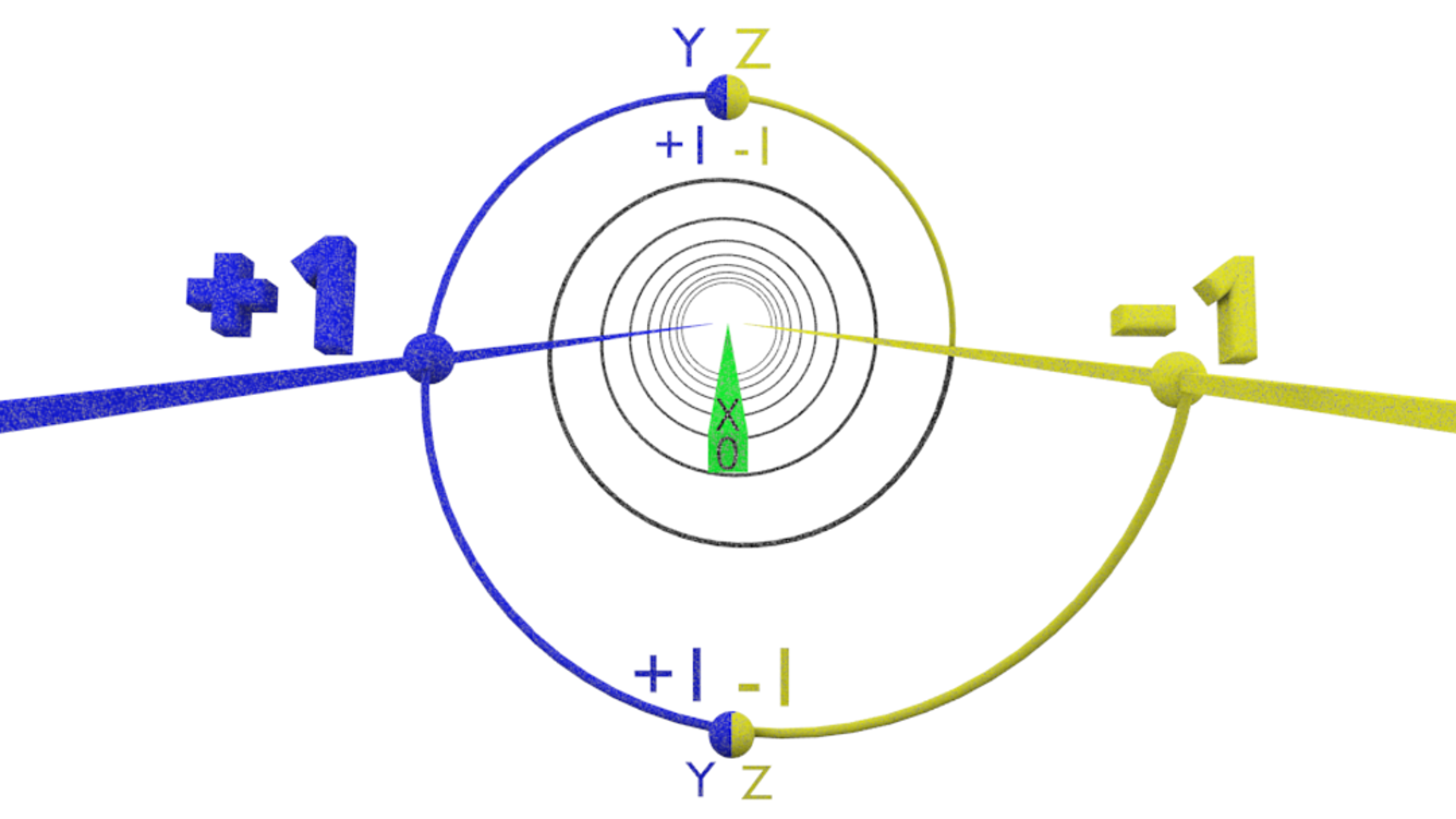
Binary has two logical states, 1 and 0. Trinary has three, +1, 0, and -1.
The third state is not a rounding of the other two, it is the state between them, and it is the state that
does the work. In an Alternating Current the waveform crosses zero on its way from positive to negative,
and that crossing is not nothing, it is the moment the field collapses and rebuilds.
Trinary Math keeps that state as a value you can calculate with, instead of throwing it away.
| State | Trinity | Visibility | Dimension |
| ----- | --------| -----------|-----------|
| (+1) | Father | Solid | 3D |
| 0 | Mother | Invisible | 0 |
| (-1) | Son | Semisolid | 1 or 2 |
| State | -------- Graph ----------------- |
| (+1) | *-------*-------*-------*------- |
| 0 | --*---*---*---*---*---*--------- |
| (-1) | ----*-------*-------*----------- |
The God Formula is (+1) + (-1) = 0.
Tycho Brahe implied this is a mathematical Truth statement, and the distinction matters to how this code is written.
An Equation asks what the unknown is. A Formula states what is already true and then holds you to it.
Every number in the Galaxy Calculator is checked against a Formula that was true before the program ran,
which is why the code never solves for anything, it only carries values forward without damaging them.
That last point is the whole reason for the next section.
2. Why Not Floating Point
JavaScript numbers are IEEE 754 doubles. A double carries somewhere between 15 and 17 significant digits,
and everything past that is gone the instant you type it.
The Milky Way radius this calculator uses carries 25 significant digits:
238229441887838.4639953874
Hand that to a double and it comes back as 238229441887838.44.
The digits past that are simply not there anymore, and no amount of care later in the program brings them back.
Multiply that damaged value by 666, double it, and multiply by Pi, and the error is no longer in the decimals,
it is in the miles.
This is why the calculator uses arbitrary precision, the same thing BC math does on the command line.
A BigNumber is not a machine word with a fixed number of bits, it is the digits themselves,
carried as text and operated on digit by digit. There is no width for a number to fall off of.
The library is bignumber.js, and the wrapper that this project actually calls
is bignumbermath.js.
There are other arbitrary precision libraries for JavaScript, and bignumber.js is the right one here
for a specific reason: it is the only one that carries toFormat built in,
which is what puts the thousands separators in the table, and its
DECIMAL_PLACES setting is the same idea as
scale in BC math. Its one gap is that it has no trigonometry,
so it cannot hand you PI. That is why PI is calculated here by series instead.
3. The Math Layer
Nothing in the calculator uses the +, -,
*, or / operators on a quantity that matters.
Every one of them is a function call, and every one of them takes and returns a string.
| Function |
Does |
Third Argument |
| plus(a, b, dp) |
a + b |
decimal places kept |
| minus(a, b, dp) |
a − b |
decimal places kept |
| times(a, b, dp) |
a × b |
decimal places kept |
| dividedBy(a, b, dp) |
a ÷ b |
decimal places kept |
| abs(a) |
strips the sign |
— |
| sqrt(a, dp) |
square root |
decimal places kept |
| format(a, dp) |
adds thousands separators for display |
decimal places shown |
| fixNumber(a) |
normalizes the string before any operation |
— |
| fixInput(a) |
takes a typed field in as text, never as a Double |
— |
| pI(dp) |
Pi from a stored 249 digit string, rounded |
decimal places, hands off to piCalc past 248 |
| piCalc(dp) |
Pi calculated by Machin's Formula, no limit |
decimal places |
The third argument is the part people miss. Precision here is declared at every single step, not inherited.
When the code writes
var trinaryMarker = dividedBy("1", "137", 13);
it is saying that thirteen decimal places is the correct precision for this value in this Formula,
and that is a decision about the physics, not about the computer.
A different precision gives a different baseline, which is exactly why the code comments warn that
changing Pi means recalculating everything downstream from it.
fixNumber runs first on every argument to every operator.
It walks the string backwards, drops trailing zeros that carry no information, and guarantees the value
always has a decimal point, so 100000.000000 becomes
100000.0 and a bare 2 becomes
2.0. Every number entering the math looks the same shape as every other one,
which is what keeps a long chain of operations from drifting.
The parentheses in this code are also deliberate. Order of precedence is never relied on,
each step is forced and stored, because the intent is to be clear, not clever.
4. The Constants
| Name |
Value |
What It Is |
| trinaryMarker |
1 ÷ 137 = 0.0072992700730 |
The Trinary Marker. Thirteen decimal places. Using 1 / 137.03599913 is not more accurate here. |
| pIe |
3.14159265359 |
Pi to 11 places, which is what Newton used. Not Math.PI. |
| cpRate |
324.540503 |
Constant Precession Rate. A mass does not react to an electromagnetic force
instantly. Drop a magnet down a copper pipe and it slows from the resistance, and touches the sides
as it falls; that deviation from the path is what this measures. It is not centrifugal force. It
scales with the size of the star and sets the error rate per iteration, and removing it makes the
distances wrong. A constant in Newton's work, found in Tesla's notes. |
| lpDensity |
73.120284 |
Atmospheric resistance, the viscosity a body passes through on the way down.
It is the resistance a meteor meets, and the reason one any faster would not get as far and one any
slower would not burn up. No published figure for it could be found, so it was reverse engineered
from reentry data, satellites decaying out of orbit, and years of SpaceX telemetry. Newton wrote the
same number down, with no note of what it was. Based on Torr, generalized to all planets. |
| Torr |
1 ÷ 760 |
A unit of pressure on an absolute scale. The word came from the Torah. |
| ringPlanetSecond |
0.001 |
A planet's second Trinary Engine ring. The rings are 0.0001, 0.001, 0.01. |
| ringSunFirst |
0.00001 |
A sun's first ring. One order of magnitude below the planet rings: 0.00001, 0.0001, 0.001. |
| trackFreqMultiplier |
0.0000000000001 |
Valence Gap Offset. An offset for the error that accumulates over an iteration,
from resistance to signal propagation, scaled on the gap between the valence rings of an atom —
the ratio holds even though the distances do not. Known as the Galaxy Ring of Power, thirteen places. |
5. The Derived Values
These are calculated once, before any track is walked. The numbers shown are the real output for the
default configuration, a Sun of 864,575.9 miles, an Earth of 7,926.2109 miles, and 333 Trinary Engines.
Atmospheric Pressure Index
1 ÷ 760 = 0.001315789
aP = 73.120284 × 0.001315789 = 0.096210865
The Atmospheric Pressure Index is a dampener. It holds back the core frequency so it expands at a known rate
for the size of the body it belongs to.
Livable Planet Ring Frequency
7926.2109 × 0.001 = 7.926
7.926 − 0.096210865 = 7.830 Hz
Earth's ring frequency comes out at 7.830 Hz.
The Schumann resonance, the fundamental of the electromagnetic cavity between the Earth's surface
and its ionosphere, is measured at 7.83 Hz.
The calculator prints this on the front page, and the Test Suite asserts it, so it cannot drift
without a test failing.
Before weighing that agreement, a reader should know that Livable Planet Density is an input constant,
not derived from anything else here, and it is numerically the value that brings this out at 7.83.
The arithmetic alone therefore cannot say whether the constant was set from the resonance or reached
independently. The author states the Schumann resonance was unknown to him when the constant was set,
which would make this a prediction rather than a fit.
That is a question about where one number came from, not about the mathematics, and it is answered by
the working that produced 73.120284, not by this calculator. It is put plainly here so anyone can
weigh it themselves.
Precession Rate
864575.9 ÷ 324.540503 = 2664
The Sun's Precession Rate, 10,656 divided by 4. This value also seeds the Maximum Error Rate,
because precession is a speed you have to overcome before you have gone anywhere.
The Three Iterations
864575.9 × 0.0072992700730 = 6311 (the Trinary Marker applied to the Sun)
maxIteration = 6311 ÷ 3 = 2103 (3 Phase)
aveIteration = 2103 − 91 = 2012
minIteration = 2103 − 1104 = 999
The division by 3 is the 3 Phase, the three states again, this time as the three phases of the cycle.
The 91 is the Sun's magnetic polarity reversals, it changes polarity 10 times a century, 0 through 9, so 100 − 9 = 91.
The 1104 came out of Newton's long running results, and it is also found in the Torah.
Notice what 999 is, and notice what it becomes when you turn it over.
Track Counts
trinaryEngines = 333 × −1 = −333 (counts up from negative)
lifeTrack = 666 (taken from Configuration, always printed)
totalTracks = ((333 × 2) × 2) + 1 = 1333
The engine counter starts at −333 and counts up through 0 to +333 and beyond,
so the Life Track sits exactly at the crossing point. That is the zero state of the God Formula,
expressed as a galaxy.
The Life Track is an input, not a constant.
Track 666 comes from the Frequency Newton used in his Gravity formula.
The Gravitational Constant is G = 6.6743e-11, and 6.666 is that rounded, measured at the center of the
body rather than at its surface. This calculator works in a different unit, so 6.66 becomes 666.
The Schumann resonance of 7.83 Hz is a surface figure, and G does not come out right against 7.83
or 783, which is what you would expect if one is taken at the surface and the other at the core.
Gravity here is an electromagnetic wave, and the value Newton gave it is the Frequency, or the
wavelength, meaning it is a result of the property rather than the property itself.
The Tracks are numbered to account for that.
That is our Solar System. It may not hold for all Life, or for all Galaxies,
so the Life Track is a field you can change, and 666 is only its default.
It has to be a Track the Galaxy actually has, from 1 up to Trinary Engines times 4,
which is 1 to 1,332 for the Milky Way. Anything outside that, or zero, or not a number at all,
falls back to Trinary Engines times 2, because every Speed in the table is divided by this
number and it can never be allowed to reach zero.
Move it and the whole Galaxy is re-scaled around the new Track, which is the point.
Put Life on Track 1000 and the Life Track Max Speed becomes
(2012 × 333) − (2664 + 1000) = 666,332 mph, and the rate per Track becomes
666,332 ÷ 1000 = 666.332.
Which is worth stopping on. That rate is not a whole number, and 1001 is.
Track 666 is the only Track in the Milky Way where the Life Track Speed divides into a whole
number of miles per hour per Track. Everywhere else the table has to round to whole miles per hour,
and the innermost Tracks come out a fraction under. The Clock still holds in the math,
the rounding is only in the display, but 666 is the one Track where there is nothing to round.
The Clock
Everything above describes one Track, the Life Track. The rest of the Galaxy is set by it.
At the Life Track the Error Rate does not have to be accumulated Track by Track,
it is known outright, because the Life Track number is what it accumulates to:
Max Error Rate = pRate + Life Track = 2664 + 666 = 3330
Min Error Rate = 0 + Life Track = 0 + 666 = 666
Life Track Max Speed = ( 2012 × 333 ) − 3330 = 666,666 mph
Life Track Min Speed = ( 999 × 333 ) + 666 = 333,333 mph
Divide each by the Life Track number and you have the Speed added per Track:
666,666 ÷ 666 = 1001 333,333 ÷ 666 = 500.5
1001 is 7 × 11 × 13, and 500.5 is 1001 halved.
Multiplying by 1001 is what repeats a three digit number, which is why the Life Track reads 666,666
and why every other Track now reads the same way. Track 333 is 333,333 mph.
Track 999 is 999,999 mph. The pattern that only showed up on one line before now runs the whole table.
6. The Track Loop
The loop runs 1,333 times, once per track. Each track is one orbital path the Sun can take around the Galaxy,
the way a groove on a record is one path the needle can take.
The engine count moves with it, starting at −333 and incrementing by one on every pass.
The Error Rates are not mistakes. They are a Calculus error handler, the error encountered on the way out
to the Life Track, which is why there is a Max and a Min operator.
They are applied once, where the Life Track anchors the Clock, and from there every track is
that rate times its own track number.
| Column |
Formula |
| Orbit Distance |
((galaxyRadius × track) × 2) × Pi |
| Max Speed |
1001 × track (the Life Track rate, times this track number) |
| Min Speed |
500.5 × track (the same Clock, at maximum amplitude) |
| Frequency |
Max Speed × 0.00001 |
| Track Frequency |
1 ÷ (0.0000000000001 × |Min Speed|) |
Because Speed is the track number times a fixed rate, every track takes the same time to go around,
and no track can come out negative. A Sun twice as far out has twice as far to travel and moves
twice as fast in miles per hour, so it arrives at the same time. Same rate, different speed.
That is the record player, and it is what Leavitt implied.
Where the engine count is at its own starting value, or at 0, 1, or −1, the Track Frequency is set to zero,
because at those points the calculation has no meaning to report.
Max Speed is the speed as the Sun begins its descent into the Galactic Plane.
Min Speed is the speed at its maximum amplitude, the top of the wave.
The Sun is riding the same waveform as the graph in section one, only the wavelength is measured in light years.
Min Speed is tied to the livable planet. It is the speed a planet orbiting that Sun would need in
order to carry Life, and most Suns will not have one. There is far less Life in the Universe than
most people assume, and on this model that is because Life needs one frequency and one speed,
not any of them.
So the two are the ends of one range, not two separate quantities.
On Track 666 the Frequency has a range that accounts for the change in speed, from 333,333 mph up to
666,666 mph, which averages 499,999.5 mph, or 223.5 km/s.
The Sun is measured at 220 to 250 km/s, which is 492,126 to 559,234 mph.
Every Sun varies to the same degree, so the Clock stays the same and only the speed changes.
Current science puts our Sun at a fixed speed, but that speed only changes over millions of years,
so a fixed figure is an assumption rather than a measurement.
The Tracks show the movement of the Suns. They are not the Spiral Arms.
The Arms show the path of the debris, which travels differently and should not be read as the same thing.
The speed range is not the vertical motion
Two motions are involved and they are not the same thing.
The vertical motion is the Sun rising above the Galactic Plane and falling back below it,
and the Sun's measured vertical velocity is about 16,219 mph, or 7.25 km/s, roughly 3 percent of its
514,495 mph, or 230 km/s, orbital speed.
The speed range of 333,333 to 666,666 mph is a factor of two, far too large to be that.
It is a variation along the direction of travel, not up and down.
Stated that way it survives the obvious objection. If every Sun varies in phase, which is what
keeps the Clock, then at any one moment every Sun at a given radius still reads the same speed,
and the variation only shows over tens of millions of years, which nobody has watched for.
What a snapshot could have refuted is Suns varying out of phase, because then stars at the same radius
would spread two to one in speed. The measured dispersion for disk stars is 44,738 to 89,477 mph, or 20 to 40 km/s,
nothing like that.
Track Frequency is the vertical waveform
The Sun does not travel a flat circle. It moves like a waveform, rising above the Galactic Plane and
falling back below it as it goes around, which is the same waveform as the graph in section one.
Track Frequency at Track 666 is 30,000,030. That is one half of a cycle, top to bottom,
which is one crossing of the Galactic Plane. It is not the time to go around the Galaxy.
half cycle, one plane crossing : 30.00 million years observed about 30
full cycle, up and back down : 60.00 million years observed about 60
The Track Frequency column reports the full cycle, 60,000,060, not the half.
full cycles in one orbit : 3.791 observed about 3.8
This number does not come from the Galaxy Radius. Halve the Radius or double it and the Track Frequency
does not move, because it comes from Min Speed and the Life Track, not from the size of the Galaxy.
You can watch this on the Galaxy Plot,
which draws a line from the center of the Galaxy out through every Sun in track order.
When the rate is shared, that line stays straight no matter how long it runs.
The page measures the spread from the table on every rebuild, so it is a test, not a claim.
7. Track 666, Worked
On track 666 the counters stand at engines = 333, Max Error Rate = 3330, and Min Error Rate = 666.
This is the track the Clock is anchored on, so it is calculated the long way, and every other track
is this result scaled by its own track number.
Max Speed = (2012 × 333) − 3330 = 669,996 − 3,330 = 666,666 mph
Min Speed = (999 × 333) + 666 = 332,667 + 666 = 333,333 mph
Frequency = 666,666 × 0.00001 = 6.66666 Hz
Track Freq = 1 ÷ (0.0000000000001 × 333,333) = 30,000,030 Hz
Orbit Dist = ((galaxyRadius × 666) × 2) × Pi = 996,895,259,518,900,613 miles
666,666 and 333,333 and 6.66666 did not get typed in anywhere.
They fell out of 2012, 999, 333, 3330, and 666, which themselves fell out of the size of the Sun,
the size of the Earth, 1 divided by 137, and a pressure unit named after the Torah.
The Torah tells us that only track 666 supports life as we know it, and this is the track where the numbers
resolve. That is the double verification the code comments talk about.
You can reach the Livable Planet frequency from the Sun's side, through Max Speed and the first solar ring,
or from the planet's side, by taking Earth's orbital distance of 584,000,000 miles,
dividing by 365 days times 24 hours to get 66,666 mph, and applying the ring.
Two independent roads, the same number at the end of both.
Here are the tracks on either side of the neighborhood, straight out of the calculator.
Every one of them is 1001 times its own track number, and every one of them takes the same
173 million years to go around:
| Track |
Engines |
Max Speed
(mph) |
Min Speed
(mph) |
Frequency
(Hz) |
Orbit Distance (miles) |
Track Frequency
(Hz, or years) |
| 665 |
332 |
665,665 |
332,832 |
6.65665 |
995,398,419,789,893,255 |
30,045,188 |
| *666 |
333 |
666,666 |
333,333 |
6.66666 |
996,895,259,518,900,613 |
30,000,030 |
| 1331 |
998 |
1,332,331 |
666,165 |
13.32331 |
1,992,293,679,308,793,869 |
15,011,296 |
One track away from 666 and the repeating digits stop resolving. That is the point.
Track 666 is the only one where the digits close on themselves, and it is the only one
the Torah says supports life.
8. Precision Notes
Two things are worth knowing if you intend to change this code or check it against BC math.
The inputs never touch a double.
The three size fields are read as text and handed to the math layer as text, through
fixInput. Nothing calls parseFloat on a
quantity, so the 28 digit radius arrives with all 28 digits:
typed in : 238229441887838.4639953874
reaches math: 238229441887838.4639953874
This is what makes the Orbit Distance agree with BC math. Run the same expression at scale 13 on the
command line and you get 996,895,259,518,900,613.4843816489474, which is 996,895,259,518,900,613 rounded,
and that is what the calculator prints.
Arbitrary precision does not protect a value that was damaged before it was handed over,
which is why the reading is done this way and not with
parseFloat. fixInput also strips commas,
so the Radius can be typed the way it is displayed.
PI is calculated, not looked up.
piCalc uses Machin's Formula, the one Newton's contemporaries
worked by hand:
PI = 16 × arctan(1/5) − 4 × arctan(1/239)
arctan(1/n) = 1/n − 1/(3n³) + 1/(5n⁵) − 1/(7n⁷) + ...
Every term is a BigNumber, and each one is the term before it divided by n squared,
so the series stops itself the moment a term rounds away to nothing. There is no limit but time.
The stored 249 digit string and the calculated value agree at every place, which is a useful check
on both of them.
Both round rather than truncate, and that matters. PI to 11 places is 3.14159265359,
which is exactly the pIe constant the Galaxy Calculator uses.
Truncating instead would give 3.14159265358, which is not PI to 11 places and would not match
the constant the whole baseline rests on.
Precision is per operation.
Because every call declares its own decimal places, changing one of them changes the baseline for
everything after it. The Pi used here is 11 places on purpose. Raising it does not make the answer better,
it makes it a different Formula, and every constant that was tuned against the old baseline
would have to be recalculated. The precision values are part of the physics, treat them that way.
9. Where Every Value Comes From
This section matters more than any single agreement on this page.
A value carried in from elsewhere is not the same as a value this calculator produced,
and the two should not be weighed alike, so here is which is which.
Measured, taken from outside this work
Sun diameter 864,575.9 miles
Earth diameter 7,926.2109 miles
Track Radius 238,229,441,887,838.46 miles, the radius of one Track, 40.52 light years.
Track 666 lands at 26,989 light years, against 26,673 measured by GRAVITY in 2019, 1.19 percent.
1 / 137 the fine structure constant, measured at 1 / 137.035999
Derived here, from measured values
maxIteration = 2103, which is the floor of
(Sun diameter × 1/137) ÷ 3. That is the one intermediate in this whole calculator that
falls straight out of measured values.
The Clock is the other. Speed rising in proportion to the Track follows from anchoring every Track to
the Life Track, and no choice of constants can break it.
Carried in from outside this calculator
These are inputs, not results. Each has an origin outside this arithmetic, and none can be re-derived
from the other numbers on this page, which is why they are listed apart rather than offered as findings.
lpDensity 73.120284 atmospheric resistance, from reentry and orbital decay data
cpRate 324.540503 the lag between a force and a mass's response, scaled on the size of the star
1104 the interval between maxIteration and minIteration
Life Track 666 Leavitt's count of the tracks, from her notes and the plate archive
trackFreqMultiplier the Valence Gap Offset, scaled on the gap between valence rings
ring constants 0.01, 0.001, 0.0001, the three rings of a Trinary Engine
So the agreements this calculator produces — 7.830 Hz against the measured Schumann resonance, 2664,
999, and the 60,000,060 that follows from 999 — are agreements between inputs carried in from elsewhere
and figures measured since. That is worth something, and it is not the same as a derivation, so it is said
plainly here rather than left for a reader to work out.
lpDensity was arrived at before the Schumann resonance was known to this work at all; the match to 7.83 Hz
was found afterwards, and is what made the value look right rather than what set it.
None of that makes the work wrong. It makes it a Formula that fits rather than a proof that holds, and it says
exactly where a proof would have to come from. Derive lpDensity, or cpRate, or 1104 from first principles
rather than from a measurement or a notebook, and each one turns from an input into a prediction.
That is the shortest path from a model that fits to evidence that stands.
What the model does not do is add anything unobservable to make the arithmetic work. There is no invisible
mass in it, and no term that exists only to close a gap. Every quantity is measured, derived from something
measured, or carried in with a stated origin.
The full comparison of every value against the current published figure is in
ACCURACY.html.
10. The Pattern
The reason all of this is one Formula and not a pile of separate calculations is that the same shape
keeps appearing at every scale.
The ground is the center, and the electron does not travel on the ground, it orbits around it.
An electron around an atom, a moon around a planet, a planet around a sun,
a solar system around a galaxy, all the same pattern, all the same math, only the scale changes.
That is why the ring constants for a sun are exactly one order of magnitude below the ring constants
for a planet, and why the Trinary Marker taken from the atom works on the Sun.
Trinary Science is based on the Newtonian Universe. Newton implied Light is Static, as proof it has no acceleration,
and implied God is the Force of Gravity in F = MA, where God is all Light without Darkness found inside all Atoms.
The Galaxy Calculator Formula and God's Formula make up one Formula that explains the Universe,
and the arbitrary precision math is simply what it takes to write that Formula down without breaking it.
← Back to the Galaxy Calculator
Galaxy Plot
Test Suite
GitHub Code Repository
Credits
Written by Jeffrey Scott Flesher.
The Science is mine: the concepts, the constants, the values, and the conclusions. Where a value came from
someone else's notes or measurements, it says so where it appears.
The code, the documentation, and the checking of the arithmetic were worked out with the help of
Claude, an AI made by Anthropic. It found errors, ran the numbers, and wrote much of the wording.
It did not decide what is true here.